

Most advice about choosing a software developer staffing agency is too lazy. It tells founders to “hire fast,” then pretends every developer seat has the same business value. That mindset burns money, because the market isn't short on all developers. It's short on the right senior engineers, especially people who can ship in cloud, AI, security, ML, and modern platform environments.
The market data backs that up. In one 2026 breakdown, contract and temporary engagements account for 63.15% of service type share, software developers hold 37.05% of the skill-set segment, and North America holds 44.05% of the global total, which means the biggest staffing pool is built around fast-moving, flexible hiring, not old-school permanent search (Direcstaff market statistics). At the same time, the broader IT staffing market is projected to grow from USD 127.75 billion in 2026 to USD 152.47 billion by 2031 at a 3.61% CAGR (Second Talent market overview). If you're buying staffing as a founder or agency owner, you need to think in terms of specialization, speed, and risk control, not just headcount.
Table of Contents
- The Real State of Developer Hiring in 2026
- Core Services and Engagement Models
- Pricing Structures and Service Level Agreements
- How TekRecruiter Can Help
- Vetting Checklist and Technical Evaluation
- Steps to Engage and Integrate Developers
- Red Flags and Strategic Decision Flow
The Real State of Developer Hiring in 2026
The biggest mistake in developer hiring is assuming there's one labor market. There isn't. The market is splitting into two separate realities, one where senior, AI-fluent, cloud, security, ML, and data talent is scarce, and another where junior hiring is comparatively weak. That split is why generic “we need developers” messaging keeps missing the mark.
Recent reporting says 71% of the increase in software-development job postings between May 2025 and May 2026 was for senior-level roles, 37% mentioned AI in the title, while junior hiring grew only 9% and entry-level roles were nearly flat at 7% (IT Wire reporting on the split market). That's the shortage. Employers aren't failing to find “developers” in the abstract, they're struggling to find developers with the exact experience stack their product roadmaps now demand.
Why generic outreach fails
A broad job post attracts broad applicants. That's not a volume problem, it's a matching problem. If your agency is sending you people because they used the right buzzwords, you're paying for keyword matching, not staffing judgment.
Senior roles are different because the cost of a mismatch compounds quickly. Academic research on developer productivity found the top 50% of developers averaged 2.44x the productivity of the bottom 50%, with a coefficient of variation of 0.55 and about 30% of observed variance explained by within-developer fluctuation (Simula study on productivity distributions). That means two candidates who look similar on paper can behave very differently once the codebase, deadlines, and team pressure change.
Practical rule: If an agency talks only about years of experience, you're talking to a resume broker. Ask how they judge output patterns, code quality under changing conditions, and role-specific task fit.
What this means for founders and agency owners
If you're hiring for a product team, stop asking for “any full-stack engineer.” Ask for the exact layer of specialization you need. A team shipping a modern frontend stack has different needs than a platform group dealing with observability, infra, or AI integration. The best agencies understand that a senior engineer who can design systems under ambiguity is a different asset from a junior dev who can execute tickets with heavy guidance.
That's also why a blanket staffing strategy wastes time. The market data says the largest share of demand still sits in temporary and contract work (Direcstaff market statistics), while the fastest-growing opportunity sits in specialized, AI-adjacent placements (Mordor Intelligence market report). If your agency is still pitching “we do everything,” they're behind the market. You want the firm that can separate real senior capacity from polished noise.
Core Services and Engagement Models
A good software developer staffing agency should be judged by how it structures risk, not by how polished its sales deck looks. The engagement model sets speed, cost, control, and liability. Choose badly, and you either pay for flexibility you do not need or trap yourself in a process that cannot move fast enough.
Contract, contract-to-hire, and direct hire
Contract staffing fits sprint-heavy work, product spikes, migrations, and temporary gaps. It is the most operationally flexible model because you can bring in people for a defined period without making a permanent commitment.
Contract-to-hire works when you like the candidate but do not want to guess on long-term fit. Use it for engineers whose work will touch architecture, ownership, or collaboration patterns you cannot fully judge from interviews alone. It gives your team time to see how someone performs under real pressure.
Direct hire belongs on core team roles, especially architectural, product-defining, and leadership-adjacent seats. If the person will own a permanent slice of your codebase, hiring them as a disposable contractor is usually false economy. Permanence makes sense when the role sets standards, not just output.
| Staffing Models Compared | Speed to Deploy | Cost Structure | Best Use Case |
|---|---|---|---|
| Contract | Fastest | Hourly or weekly billing | Sprint acceleration, temporary gaps, short projects |
| Contract-to-hire | Fast | Transitional billing, conversion later | Testing fit before permanent commitment |
| Direct hire | Slower | Flat placement fee or salary-linked fee | Core architectural and long-term team roles |
Freelance marketplaces versus staffing agencies
Freelance marketplaces are built for self-service speed. You browse profiles, compare rates, and try to manage quality yourself. That can work for isolated tasks, but it pushes vetting, legal setup, and consistency risks onto your internal team.
A staffing agency does the opposite. It packages sourcing, screening, coordination, and often contractual handling into one relationship. That matters when your engineering leads are already overloaded. It also matters when you need a partner who can separate a polished generalist from a genuine senior specialist.
Staffing agencies versus traditional recruiters
Traditional recruiters are often strongest on permanent placement and relationship management. They are useful for executive searches, but many do not have deep technical screening muscle. A real software developer staffing agency should be faster and more operationally flexible, especially when the role is contract-heavy or the tech stack is specific.
You should expect a staffing partner to save your senior engineers from wasting hours on weak candidates. If the agency is not reducing internal interview load, it is not earning its fee.
The practical selection rule is simple. If the work is temporary and urgent, use contract staffing. If the role is strategic but uncertain, use contract-to-hire. If the person will shape the future of the team, go direct hire. Anything else is paying for the wrong mechanism.
Pricing Structures and Service Level Agreements
Pricing is where many agency relationships get sloppy fast. The fee itself matters, but the hidden cost is usually process drift. If the agency can't commit to timelines, candidate quality, and replacement terms, you're not buying staffing, you're buying chaos with a logo on it.
The main pricing shapes
For contract roles, agencies usually charge through an hourly markup on top of the contractor's pay. That structure makes sense because you're buying flexibility and rapid deployment, not a permanent search outcome. For direct hire, the fee is usually flat or salary-linked, and the agency gets paid when the candidate starts.
Retainer models are reserved for harder searches, especially senior or confidential roles. You use them when the candidate pool is narrow and the upside of the hire is high. The logic is simple, if the wrong senior engineer can slow product delivery for months, paying for a more disciplined search is cheaper than making a bad call.
What should be in the SLA
A real Service Level Agreement should define how the agency works, not just what it charges. I'd insist on these items before a search starts.
- Submission timing: How quickly will qualified candidates be delivered after intake?
- Interview turnaround: How fast does the agency move between your feedback and the next slate?
- Screening depth: Who performs the technical screen, and what rubric do they use?
- Replacement terms: What happens if a hire fails early?
- Communication cadence: Who owns weekly status updates and calibration?
If an agency won't put the process in writing, it's already signaling weak discipline. The contract should protect you from dead time, misalignment, and candidate churn. It should also spell out who owns IP, who owns communication, and how disputed placements are handled.
How to negotiate without sounding cheap
Don't ask for “the best rate.” Ask for the terms that reduce your risk. A lower fee means nothing if the agency floods you with unqualified submissions or vanishes after the start date. Push instead for stronger screening, tighter replacement language, and clear response windows.
Best negotiating move: Trade volume for service quality. If you can offer multiple roles or an ongoing search relationship, ask for better accountability, not just a discount.
For specialized engineering roles, the fee should buy judgment, not just access. That's the key distinction between a staffing partner and a resume vendor. A serious agency protects your time, protects your team, and absorbs some of the risk when the hire doesn't work out.
How TekRecruiter Can Help
TekRecruiter is built for companies that want a more technical hiring process, not a louder sales pitch. The firm positions itself around engineers recruiting engineers, which matters because technical screening is only useful if the people doing it can distinguish strong architecture thinking from polished interview theater.
That approach is especially relevant when you need help across Software Engineering, AI Engineering, DevOps, SRE, Platform Engineering, Cloud and Systems Engineering, Data and Data Analytics Engineering, Salesforce Engineering, ERP Engineering, and Cybersecurity Engineering. If your hiring problem is specialized, that kind of breadth is useful because it lets one partner map talent across multiple adjacent roles without flattening everything into generic “developer” language.
For founders who want local market context, a useful resource is this software developer staffing agency in Miami, especially if you're evaluating regional talent access against national reach. TekRecruiter also supports Direct Hire, Staff Augmentation, On-Demand, and Managed Services, so the firm can fit both permanent buildout and short-term delivery pressure.
The core reason to consider a firm like this is simple. If your internal team keeps wasting time on candidates who look fine on LinkedIn but fail technical depth checks, you need a partner that screens with more rigor than keyword matching. TekRecruiter's model is a fit when the bottleneck is candidate quality, not just pipeline volume.
Vetting Checklist and Technical Evaluation
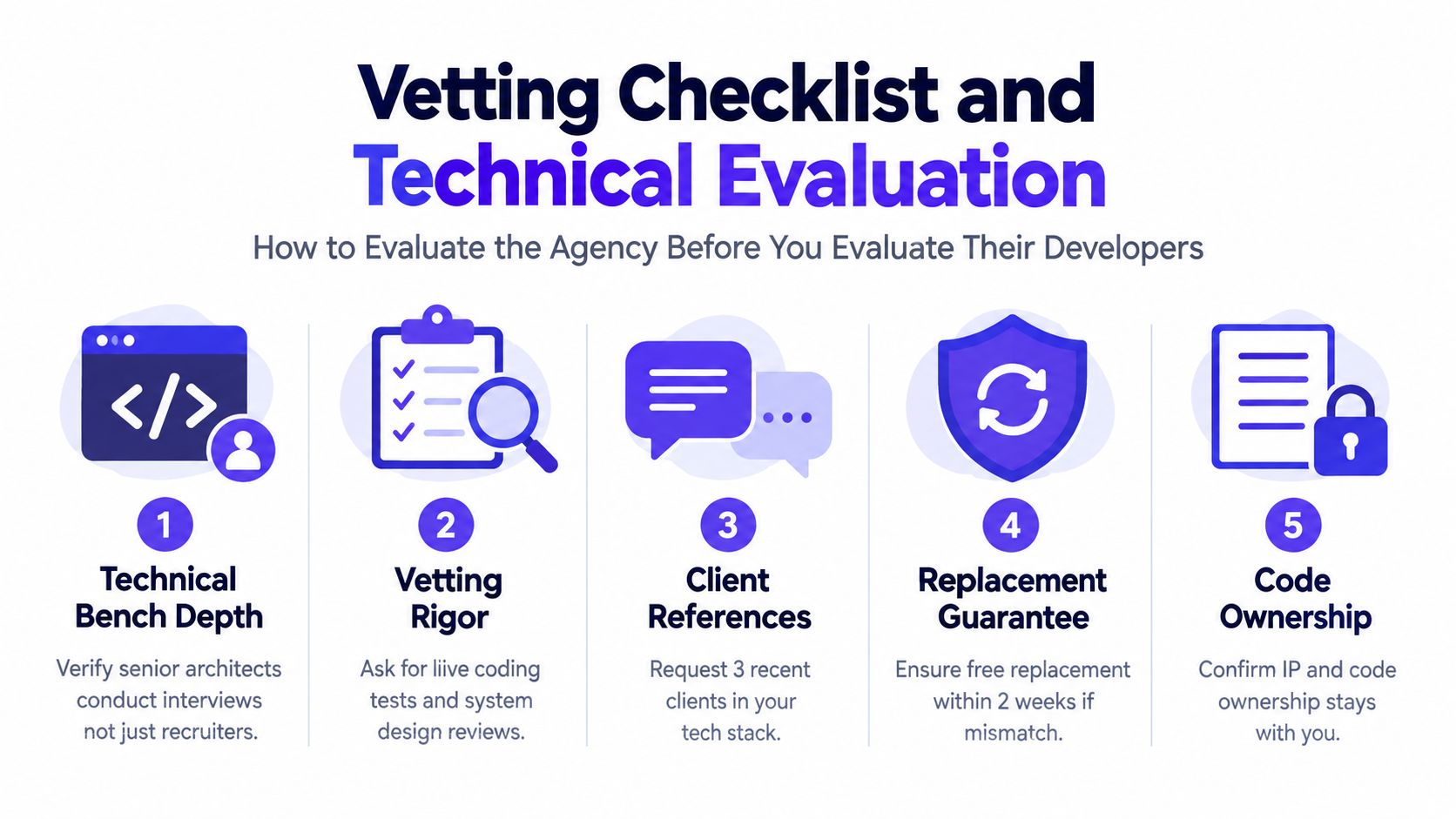
Treat a staffing agency like a technical vendor. If they cannot explain how they screen developers, they do not understand the job they are selling. Start with the people doing the evaluation. You want engineers or technical leaders judging code, architecture tradeoffs, and delivery behavior, not recruiters reading keywords off a résumé.
Ask these questions before you sign
Be blunt. Strong agencies answer with specifics. Weak ones hide behind process language.
- Who performs the technical screen? If the answer is “our recruiters,” ask what engineering background they have.
- What does your rubric measure? The answer should cover debugging, system design, code quality, and role fit.
- How do you distinguish senior from mid-level? Years of experience are not enough.
- Can you show me a recent example of how you rejected a candidate? A firm that never rejects anyone is not screening thoroughly.
- How do you validate modern stacks? If they cannot speak concretely about tools like Tailwind CSS or React, they are probably just collecting resumes.
The reason is simple. Engineering output varies a lot even among candidates with similar résumés, especially once the work gets messy, as noted earlier in the productivity variance research. A serious agency screens for that spread instead of pretending every profile tells the same story.
The operational steps that should happen after candidate intake
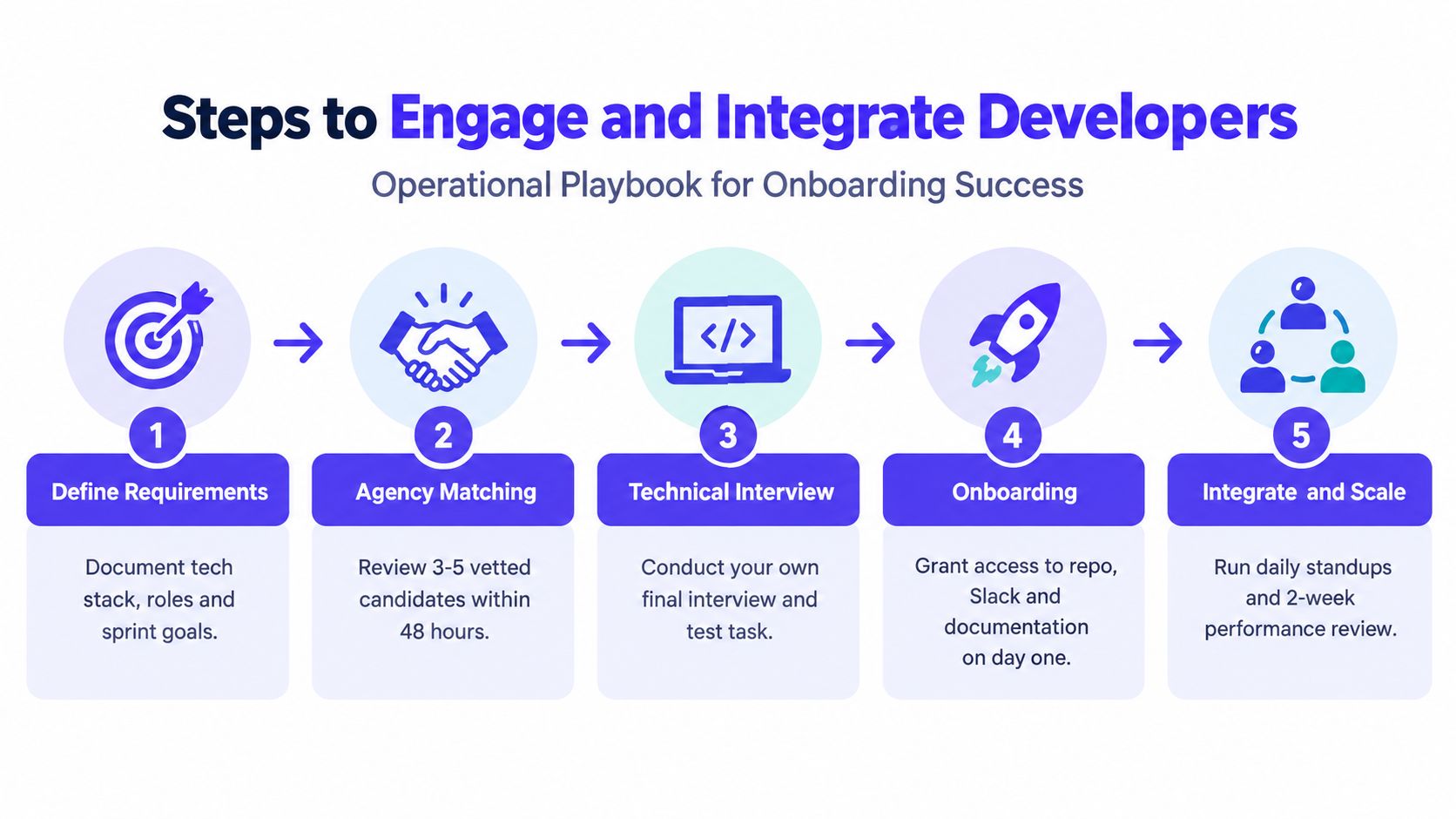
- Define the role precisely. Document the stack, delivery goals, collaboration model, and what success looks like in the first few weeks.
- Demand a technical slate, not a resume pile. The agency should bring a small set of candidates who already passed a real screen.
- Run your own final interview. Use one practical coding discussion and one system-design conversation.
- Check code ownership and contract terms. Make sure IP and deliverables belong to your company.
- Review the first two weeks carefully. Track communication quality, responsiveness, and whether the person can operate inside your workflow.
If the agency cannot explain how it evaluates actual developer output, it is not a partner. It is a distribution channel.
What a strong agency should prove
A strong agency should explain how it separates keyword matching from technical judgment. It should also understand that staffing quality is not just about placing someone who can write code, but placing someone who can work inside a specific team, sprint cadence, and codebase. That matters even more for software teams using component-driven frontends, cloud-heavy infrastructure, or AI-adjacent systems.
The best agencies do not win by sounding broad. They win by showing why one candidate fits your product stage and another one does not.
Steps to Engage and Integrate Developers
Hiring through an agency only works if you can integrate the person cleanly. The fastest way to ruin a good placement is to leave them blocked on access, tooling, or unclear ownership. The first two weeks should be structured enough that the new developer can contribute without dragging your senior staff into repeated hand-holding.
The onboarding sequence that actually works
Day one should be boring in the best way. Give the developer repo access, Slack access, documentation, and a named internal contact who owns answers. If they spend the first day waiting on permissions, you've already wasted part of the fee you paid to move fast.
The second move is environment setup. Don't assume they'll guess the right local tooling, branch rules, or CI/CD expectations. Send a short written setup guide, or you'll burn time on avoidable friction.
What to do in the first two weeks
- Define the first task early: Give them a narrow, real piece of work that touches your codebase.
- Schedule one technical check-in: Use it to catch setup issues, not to micromanage.
- Expose them to your standards: Code review norms, ticket hygiene, and release cadence matter immediately.
- Pair them once, then let them work: Too much shadowing slows the ramp.
- Review output, not effort: The goal is useful commits and reliable communication.
The most common mistake is treating a contractor like an outsider and then acting surprised when they never fully engage. If you want them to deliver, they need context. If you want context to transfer quickly, your team needs to be deliberate about it.
When an agency is the right call
Use an agency when the role is urgent, specialized, or hard to source through your own network. That is especially true for contract-heavy work, niche senior engineers, and cases where your internal team doesn't have time to run a deep search. Use internal recruitment when the role is stable, repeatable, and easy to benchmark. Use freelancers when the task is narrow and isolated.
If the agency can help you move fast without lowering the bar, it's earning its keep. If your onboarding still feels chaotic after two weeks, the issue is usually the process, not the developer.
Red Flags and Strategic Decision Flow
Bad agencies expose themselves fast. They dodge technical detail, flood you with irrelevant resumes, and bury the contract terms that control your downside. If you see that pattern, end the conversation.
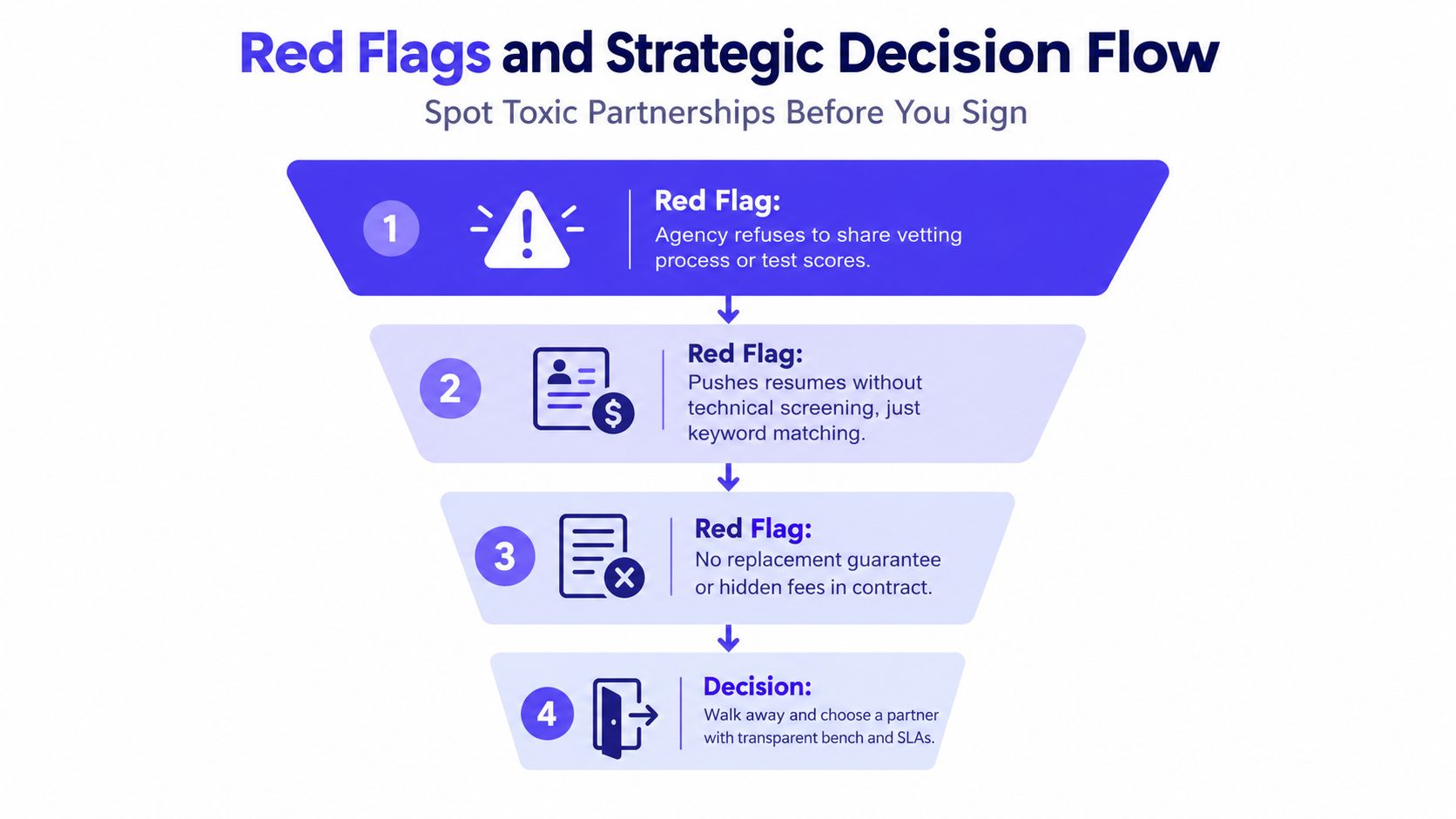
The four red flags that should end the conversation
First red flag, no vetting transparency. If the agency will not show how it screens candidates or what it tests, you are being asked to trust a black box. That is a poor fit for technical hiring.
Second red flag, keyword-only matching. Some firms send resumes that look relevant because the title matches. That is not enough for software work, where architecture judgment and delivery habits matter more than surface keywords.
Third red flag, weak contract protection. If there is no clear replacement path or the fees are hidden in vague language, your downside is too high. Protect the deal before the first candidate is introduced.
Fourth red flag, no understanding of the stack. If the account manager cannot speak clearly about your environment, the agency is not calibrated for your needs. That gap shows up later as weak submissions and slow correction.
The decision flow that should guide your hiring method
Use a software developer staffing agency when the role is specialized, the timeline is tight, or the internal team cannot screen thoroughly enough. Use direct recruiting when you can afford a slower search and want tighter control over the employer brand. Use freelance channels when the work is bounded and you do not need long-term accountability. Use internal upskilling when the gap is in capability, not headcount.
A smart team does not use one hiring method for everything. It matches the method to the risk. A senior engineer who owns architecture deserves a different process from a short-term contributor who closes a narrow backlog.
The core decision isn't agency versus no agency. It's whether the business problem you're solving justifies the added cost, the added speed, and the added screening discipline.
If you are still unsure, ask one question: will a bad hire in this role slow the company down enough to justify external expertise? If yes, use the agency. If no, do not pay for one.