

You're staring at a Figma handoff, the designs are clean, the Tailwind classes are obvious, and the first pass from your remote developer looks right. Then review starts. One clarification turns into five comments, the answers land the next day, and a UI that should've shipped on Wednesday is still waiting for Thursday's overlap window. That's the nearshore vs offshore decision for frontend teams, not a neat procurement slide.
For UI work, the difference isn't just geography. It's whether your team can preserve enough live context to protect design fidelity, or whether the work is standardized enough that async handoff won't break it. Nearshore usually means nearby countries with stronger working-hour overlap and easier day-to-day coordination. Offshore usually means distant delivery centers with larger time-zone gaps, deeper talent pools, and lower headline rates.
| Factor | Nearshore | Offshore |
|---|---|---|
| Time-zone overlap | More shared working hours, often enough for live review and same-day clarification | Less overlap, more dependence on written handoff |
| UI iteration | Better for ambiguous product work and feedback-heavy design changes | Better for clearly specified, repeatable execution |
| Communication rhythm | Easier synchronous standups, reviews, and unblockers | More structured async process and documentation |
| Talent availability | Smaller pool, but often closer cultural and business alignment | Larger pool, especially for hard-to-hire roles |
| Cost profile | Usually above traditional offshore, below onshore | Usually the cheapest labor option |
Table of Contents
- Nearshore Vs Offshore For UI Work
- Comparing Nearshore And Offshore Delivery Models
- Cost, Hidden Friction, And Real Delivery Expense
- How Virtustant Can Help
- How Component Libraries Change The Traditional Tradeoffs
- IP Protection, Legal Jurisdiction, And Data Access
- When To Choose Nearshore, Offshore, Or A Hybrid Approach
Nearshore Vs Offshore For UI Work
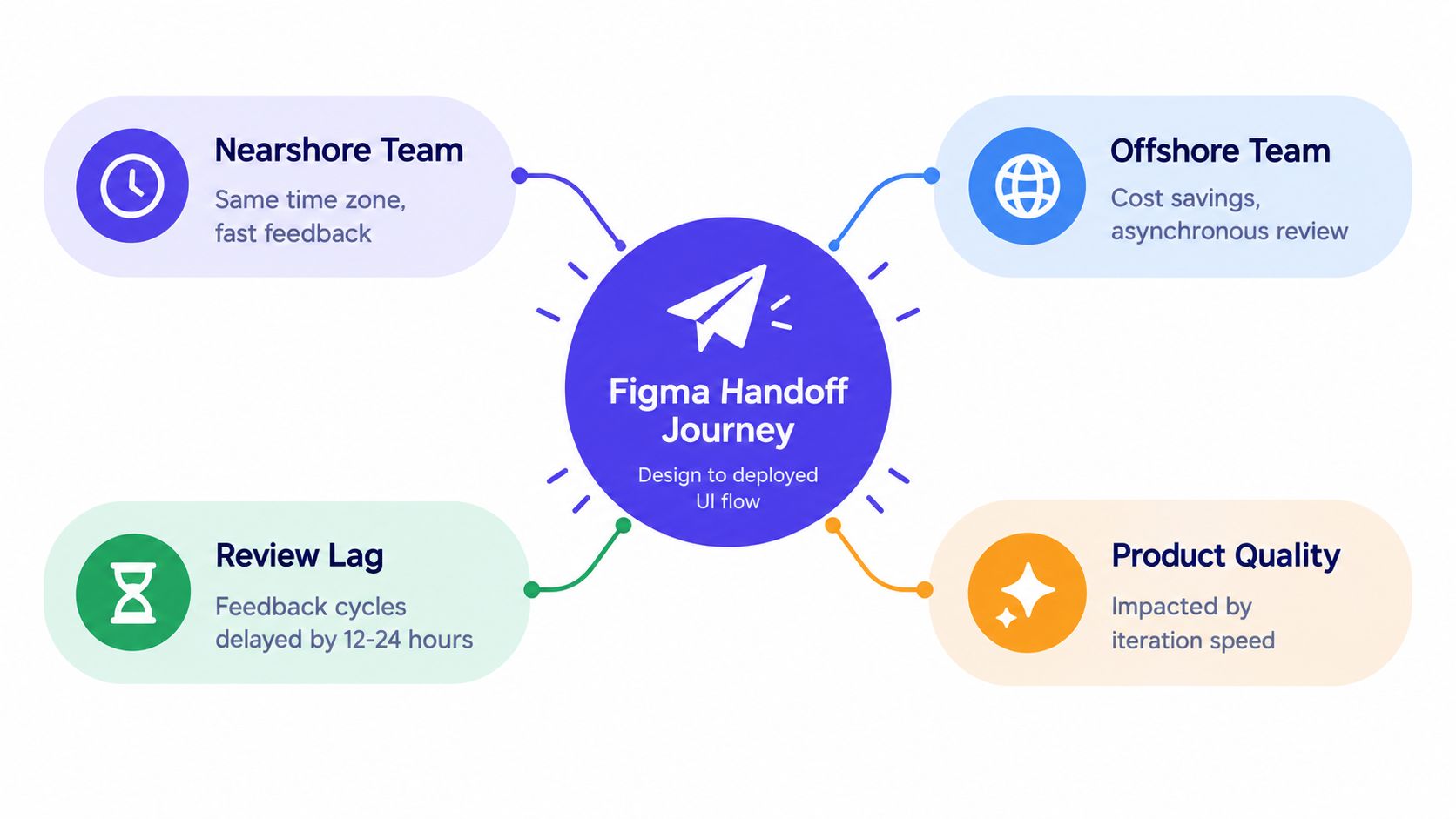
The fastest way to understand this choice is to follow a single UI task from start to finish. A designer hands off a Figma file, a frontend engineer implements it, QA finds a spacing bug, and product asks for a copy tweak. If the people doing that work share enough of the same day, the team can close the loop before context evaporates. If they don't, every round trip becomes a wait.
That's why the cleanest definition of nearshore vs offshore for UI teams isn't “cheap versus expensive.” It's overlap versus latency, clarity versus ambiguity, and feedback speed versus handoff discipline. Nearshore works best when the design is still being shaped and the team needs fast human judgment. Offshore works best when the pattern is already known, the UI is highly repeatable, and the work can be broken into pieces without losing meaning.
What changes for frontend teams
Frontend is unusually sensitive to coordination friction because implementation choices leak back into design. A button variant that looks fine in isolation can break a page rhythm, a modal can force a state-management decision, and a tiny copy change can shift layout in ways a screenshot never revealed. The work isn't just coding. It's interpretation.
That's where time-zone overlap becomes a practical quality lever. Nearshore arrangements often preserve four to eight hours of daily overlap, while offshore setups often leave zero to four hours of synchronous contact (Rorix Tech). In collaboration-heavy UI work, that overlap decides whether a designer, developer, and PM can resolve a question in minutes or wait a full cycle.
Practical rule: if the task needs live judgment, design intent, or trade-off discussion, put it where people can talk in the same working day.
Where the labels stop being useful
The labels are less important than the type of work. A landing page built from a reusable system is not the same problem as a product dashboard with changing states, edge cases, and stakeholder input. One can be assembled with minimal conversation. The other needs fast back-and-forth, because the requirements keep moving as people see the UI in context.
A senior frontend lead should ask one question before picking a model. Is this a standardized page build or an ambiguous product iteration? The answer usually tells you more than the country name. If the work is stable and the acceptance criteria are explicit, offshore can perform well. If the team still needs to discover the right pattern together, nearshore usually ships cleaner.
Comparing Nearshore And Offshore Delivery Models
A product team can lose a day on a small UI decision. A designer flags a spacing issue, the developer interprets the comment differently, and the reviewer sees the result after the original context has gone cold. Nearshore collaboration shortens that loop. Offshore delivery can still produce excellent work, but it relies more heavily on clear written decisions, complete tickets, and stable acceptance criteria.
An MJV Innovation analysis of nearshore delivery models reports that each additional hour of temporal distance reduces synchronous communication by 11% and spontaneous alignment opportunities by 19% (MJV Innovation). For frontend teams, the practical effect is fewer chances to catch a misunderstanding before it reaches review, QA, or production.
Side by side on the factors that ship UI
| Factor | Nearshore | Offshore |
|---|---|---|
| Design-to-dev fidelity | Strong when design and development can co-review in real time | Strong when specs are detailed and stable |
| Iteration speed | Faster on changing requirements | Slower when feedback depends on live discussion |
| Communication latency | Lower, because overlap supports same-day clarifications | Higher, because handoffs often cross time zones |
| Cultural alignment | Usually closer to the client's business norms | Can be excellent, but often needs more explicit process |
| Review efficiency | Easier to unblock during the same day | Depends heavily on written context and ticket quality |
Geography matters less when the workflow removes ambiguity. A page assembled from a defined component library, with documented variants and acceptance criteria, can move through an offshore handoff without constant live discussion. Libraries such as Pagedone can make that approach more practical by giving designers and developers a shared set of standardized Tailwind patterns to reference.
The trade-off changes with the work. A dashboard with changing states, unclear requirements, and frequent product decisions still benefits from nearshore overlap. A stable page build with known components can tolerate more distance, provided the team documents the intended behavior rather than only the visual target.
A UI team that cannot ask quick questions needs stronger documentation, clearer screenshots, and more deliberate approval steps.
Communication is a production constraint
Fast frontend work depends on alignment, not a high volume of status updates. Cultural proximity can reduce misunderstandings around spacing, priority, responsive behavior, and business intent. Those details are easy to resolve in a short working session and expensive to reconstruct after several handoffs.
Offshore remains effective for large-scale execution when the scope is defined and the delivery process is disciplined. Nearshore earns its premium when the team must make decisions together, test ideas in context, or adjust the interface as stakeholders react to working software. Standardized UI work can survive asynchronous delivery. High-interaction product work usually needs overlapping hours and rapid feedback.
Cost, Hidden Friction, And Real Delivery Expense
A page can have a low hourly rate and still become the expensive option. Rework, delayed approvals, and repeated explanations add internal cost that never appears on the vendor invoice. Frontend teams notice it quickly because a small UI misunderstanding can send the work back through product, design, development, and QA.
The market shows demand for both models. A 2026 industry roundup from TechRT reports that nearshore demand in North America rose by nearly 20% during 2024, while over 70% of global outsourcing contracts still involved offshore delivery locations, mainly in Asia. According to GITNUX's 2024 outsourcing statistics report, nearshore spending reached $146.2 billion in 2023 after growing 12.4% that year, while offshore outsourcing delivered 50-60% cost savings compared with onshore and nearshore models offered 20-30% savings over offshore with better quality.
The three cost layers that matter
Baseline labor cost is the visible line item. Offshore usually wins this comparison.
Coordination cost includes the hours your internal team spends clarifying requirements, reviewing mismatched work, explaining decisions again, and waiting for responses. Nearshore often reduces that expense because working-hour overlap shortens the feedback loop.
Rework cost appears when a UI is implemented correctly against the wrong interpretation. Vendors rarely price this cleanly, yet your team still pays for the correction through delayed releases and extra review cycles.
A component library changes the calculation. With Pagedone or another consistent Tailwind system, developers can work from known patterns, documented variants, and defined responsive behavior. That makes asynchronous handoff more workable for stable pages and repeated interface elements. The library reduces interpretation risk, but it does not resolve unclear product decisions or complex interaction states.
Cost is not the same as value
Offshore is often the better financial choice when requirements are complete, acceptance criteria are specific, and the team can absorb slower feedback. Standardized UI production can support that setup, particularly when each handoff includes the relevant component, state, breakpoint behavior, and approval context.
Nearshore earns its higher rate when the work changes during implementation. Interactive filters, data-heavy dashboards, onboarding flows, and behavior that depends on product judgment benefit from overlapping hours. A short working session can prevent a day of rework.
The leadership mistake is treating the hourly rate as delivery cost. A cheap build that misses the design system, introduces regressions, or stalls in review is expensive by the time it reaches production.
How Virtustant Can Help
Virtustant is a remote staffing agency that connects U.S. companies with vetted professionals across Latin America for full-time remote roles, and it sits squarely in the nearshore part of this conversation. Its model is useful when a frontend team needs time-zone overlap, strong English, and a faster way to fill roles without building a recruiting machine from scratch. More details are available on Virtustant's compare-agencies page, which is worth scanning if you're comparing nearshore staffing options.
For UI teams, the main value is not “cheap labor.” It's compressed hiring time, less screening noise, and a cleaner path to people who can sit close enough to your working hours to participate in review cycles. That matters for designers, developers, project managers, QA, and anyone who has to keep a Tailwind UI moving without long delays between handoff and feedback.
Virtustant's model is especially relevant when the job needs cross-border coordination but still benefits from a managed hiring process. It handles sourcing, vetting, contracts, payroll, HR, and compliance under one arrangement, which reduces the operational mess that often comes with international hiring. That makes it easier to think about staffing in terms of output and collaboration, not admin drag.
If your team is deciding between building a nearshore bench internally or outsourcing the recruiting and employment layer, this is the kind of provider that can shorten the path. The fit is strongest when you need bilingual or high-English professionals in Latin American time zones, and when you care more about daily collaboration than about squeezing the absolute lowest hourly rate out of the market.
How Component Libraries Change The Traditional Tradeoffs
A lot of nearshore vs offshore advice assumes frontend work starts from a blank screen. It doesn't. Mature teams rely on component libraries, design systems, and reusable patterns that turn much of UI production into assembly instead of invention. That shift changes the delivery math.
Pagedone is a good example of the kind of library that alters the equation. It offers Tailwind CSS components, page blocks, templates, and matching Figma assets, which means design and code can share a common vocabulary before anyone writes a custom implementation. When the team is building from reusable blocks, less of the work depends on real-time invention. That makes asynchronous delivery more viable.
Standardized work can travel farther
If your team is stitching together common pieces like buttons, cards, navbars, modals, forms, tabs, and pricing sections, the coordination load drops because the building blocks are already agreed on. In that scenario, offshore becomes more attractive for volume work because the task is less about interpretation and more about accurate execution. The same is true for page-level assembly, component integration, and QA on known patterns.
Nearshore still matters, though. The moment the work becomes product-facing, ambiguous, or tied to ongoing design decisions, overlap starts paying for itself again. Discovery, layout decisions, and interactive edge cases are still easier when the designer and engineer can talk live. Component libraries don't erase that need. They narrow it.
Useful split: keep ambiguous product work nearshore, and move predictable implementation to the model that can absorb async handoff without quality loss.
A practical operating model for frontend teams
Think in terms of task type, not team ideology.
- Discovery and UX iteration belong nearshore when the design is still evolving and the product owner needs fast answers.
- Component assembly and page production can go offshore when the library is mature and the acceptance criteria are explicit.
- QA and regression checks can sit either way, but they work best when the UI patterns are already standardized.
- Design-system co-creation works well nearshore because the team can reconcile code and Figma quickly.
The hidden benefit of a strong component library is that it reduces the number of conversations required per page. That does not make communication unimportant. It makes communication more targeted. Instead of debating every pixel, the team can focus on exceptions, interactions, and business logic.
For legal and operational safety, the practical safeguards stay the same regardless of location. Keep source ownership explicit, limit access to what each contributor needs, use clear branch and review rules, and make sure the handoff path is documented. The more reusable your UI stack becomes, the more the outsourcing decision turns into governance rather than guesswork.
IP Protection, Legal Jurisdiction, And Data Access
Frontend teams often underestimate how much proprietary material sits inside a UI project. A design system is intellectual property. So are component variants, spacing rules, animation behavior, and the conventions that make a product feel coherent. If a vendor touches that work, you need clarity on ownership and access from day one.
Nearshore arrangements can feel simpler because the business culture and legal expectations are often closer to what U.S. teams are used to. That doesn't make them safer by default, but it can reduce ambiguity when you're assigning code ownership or deciding who can access internal assets. Offshore can work just as well, but it leans harder on explicit contracts and process discipline.
What to ask before work starts
- Who owns the code and assets? Make the IP assignment language unambiguous.
- Who can access the repository and design files? Grant the minimum needed access.
- How are reviews approved? Tie merges to named reviewers and acceptance criteria.
- What happens when a hire leaves? Ensure the handoff path is written down.
- Where are sensitive files stored? Keep internal systems separated from broad vendor access.
These aren't legal niceties. They're operational controls. If a vendor is building against your internal component system, the wrong permission model can create problems long before a contract dispute does.
Handoff discipline protects both models
Version control is the quiet safeguard that keeps cross-border UI work from drifting. Clean branches, predictable review rules, and visible change history make it easier to prove what changed and why. That matters if you're working with a nearshore partner, and it matters even more when the team is offshore and you rely on async review to preserve context.
The safest stance is not to assume that geography solves governance. It doesn't. Use geography to reduce friction, then use process to control risk. That combination is what keeps design systems and proprietary UI logic from becoming a liability.
When To Choose Nearshore, Offshore, Or A Hybrid Approach
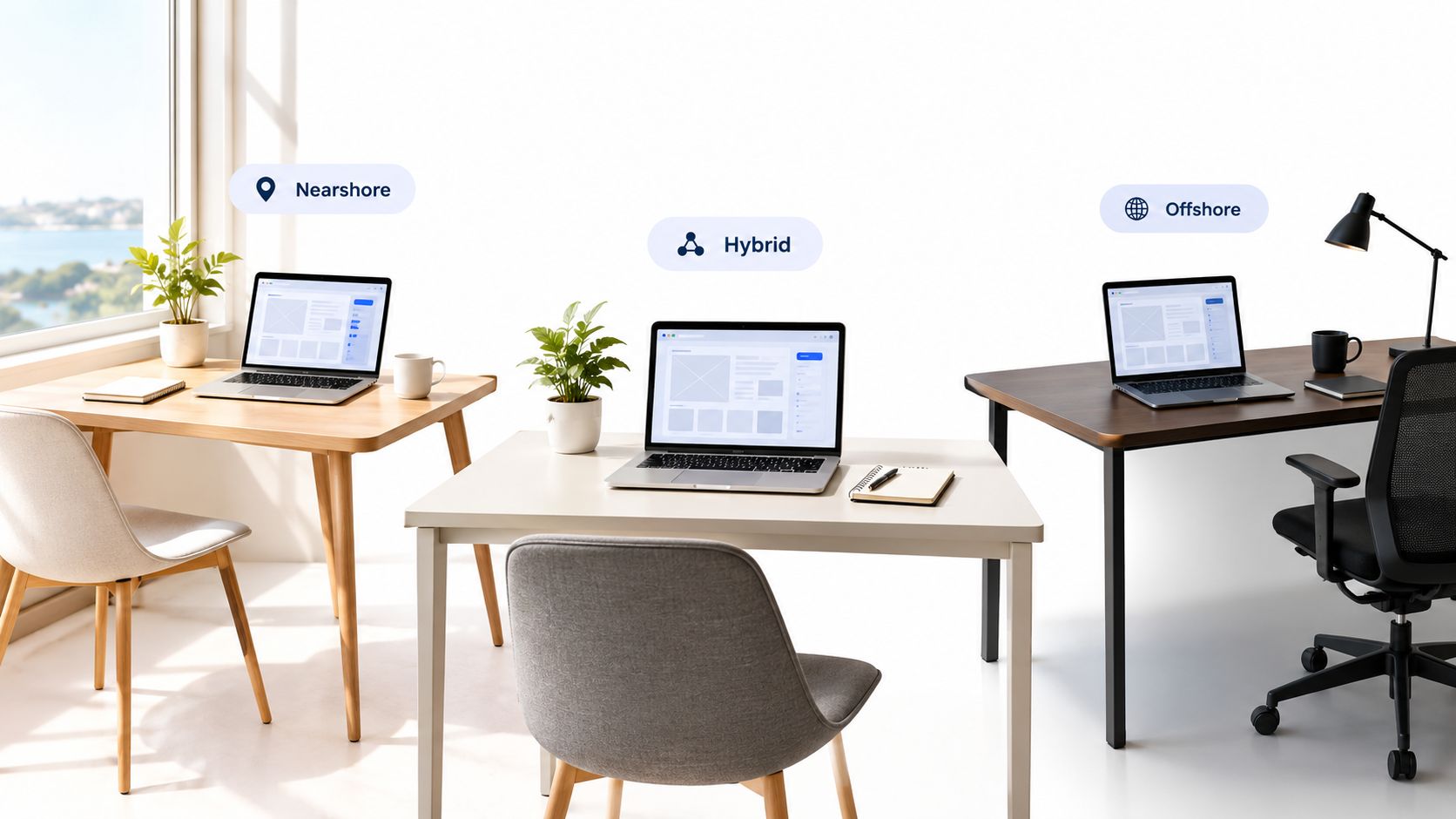
If your product team is still discovering what the UI should be, choose nearshore. If your work is standardized, high-volume, and already defined in a reusable system, offshore can be the better economics play. If you need both speed and scale, use a hybrid model and split the work by task type instead of forcing one geography to do everything.
The hybrid answer is usually the most realistic for frontend teams. Discovery, stakeholder-facing iteration, and design-system decisions fit better nearshore. Repetitive build work, template application, and production QA can live offshore once the patterns are stable. The split works because the same component library that reduces effort also reduces the amount of live coordination required.
A decision checklist that matches how UI really ships
- Choose nearshore when the UI is still changing, the team needs same-day feedback, or product judgment matters more than raw throughput.
- Choose offshore when the design system is mature, the scope is frozen, and the team can document handoff cleanly.
- Choose hybrid when you need both fast collaboration and lower-cost production capacity.
- Avoid pure rate shopping when quality depends on design fidelity, because the cheapest hourly number can cost more in rework.
- Match location to task type instead of choosing one model for every kind of frontend work.
The best outsourcing model is the one that matches your revision cycle, not the one that looks cheapest in isolation.
If you're deciding for a real project, start with the work itself. Map which parts require live design discussion, which parts are routine, and which parts can be handed off cleanly with a reusable component library. That's the only way to make nearshore vs offshore a delivery decision instead of a slogan. For teams building in Tailwind, Pagedone is a strong reference point for what standardized UI can look like when the code and Figma assets stay aligned.