

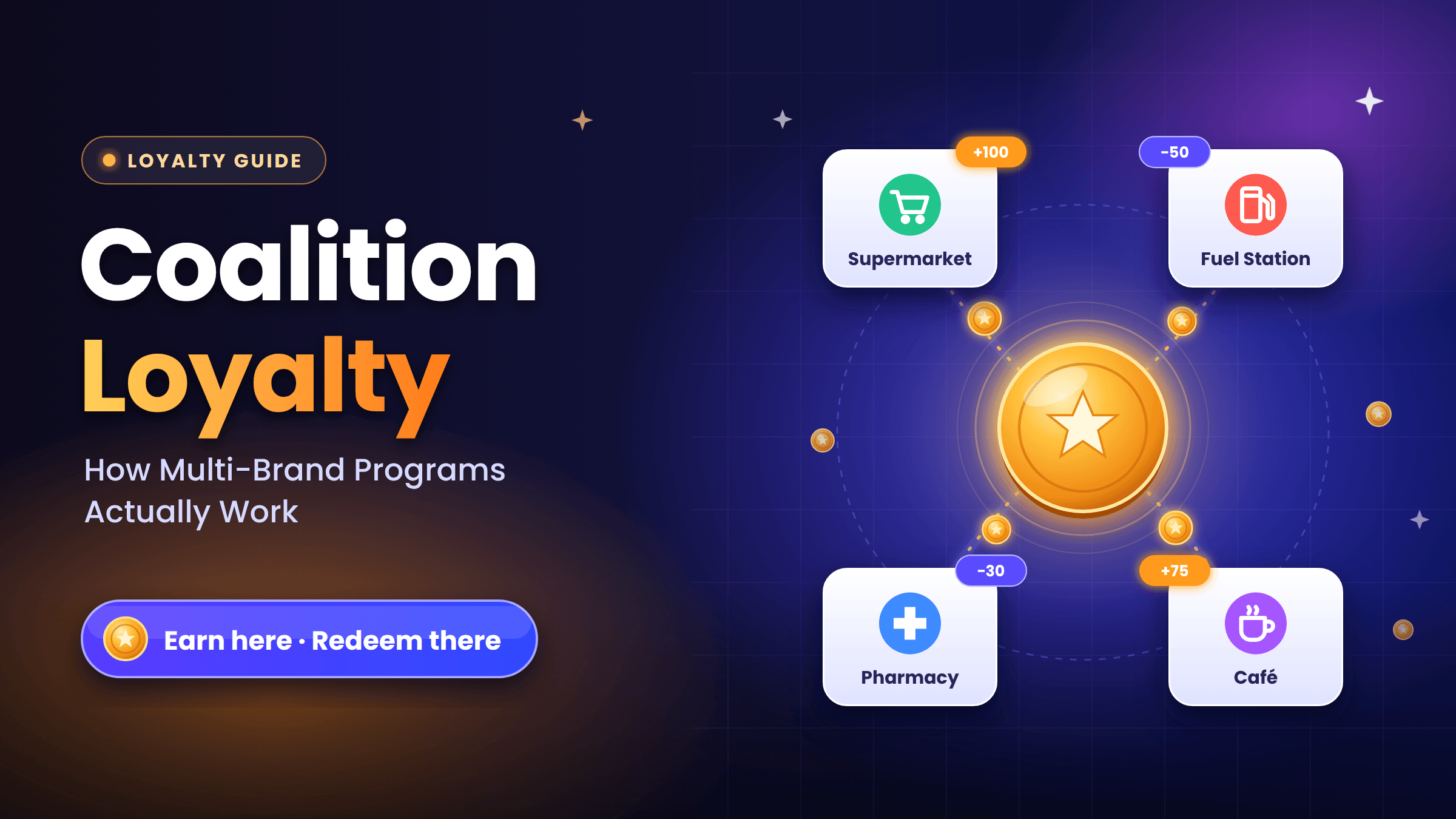
What if customers could earn points at your store and redeem them at another business? That’s how coalition loyalty programs work.
You and other businesses join the scheme as partners, agree on how customers earn and redeem points, and give them more ways to use the rewards they collect.
In this article, we’ll discuss why your brand might benefit from joining one and how choosing the right loyalty technology is essential to success.
What Is a Coalition Loyalty Program?
A coalition loyalty program is a rewards program that lets customers earn and use points across different businesses.
For example, if you run a supermarket, customers can earn points when they shop with you and use them at partner businesses, such as a fuel station or pharmacy. Likewise, their customers can use the points they earned to claim benefits from your business.
Coalition Loyalty vs. Single Brand and Partner Programs
The easiest way to understand coalition loyalty is to compare it with the two other types of rewards programs.
| Feature | Single brand program | Partner program | Coalition program |
|---|---|---|---|
| Who runs it | You run the program for your brand | You run the program and work with selected partners | An operator coordinates several participating brands |
| Where members earn | At your brand | Mainly at your brand, sometimes with partners | Across the network |
| Where members redeem | With your brand | Mainly with your brand | Across participating brands, subject to program rules |
| How it creates value | Encourages repeat purchases from you | Adds benefits through selected partners | Connects spending and rewards across several businesses |
| Example | A coffee chain’s app | A hotel program that awards points for car rentals | yuu Rewards in Hong Kong |
The main difference is who runs the program. If you operate a partner program, you own the loyalty scheme and decide which partners to add. In a coalition, you share a rewards network with other brands, and a central operator coordinates the common program.
How a Coalition Loyalty Program Works
In a coalition program, the operator coordinates the network, but you still need to understand how your points, money, and customer information move through it.
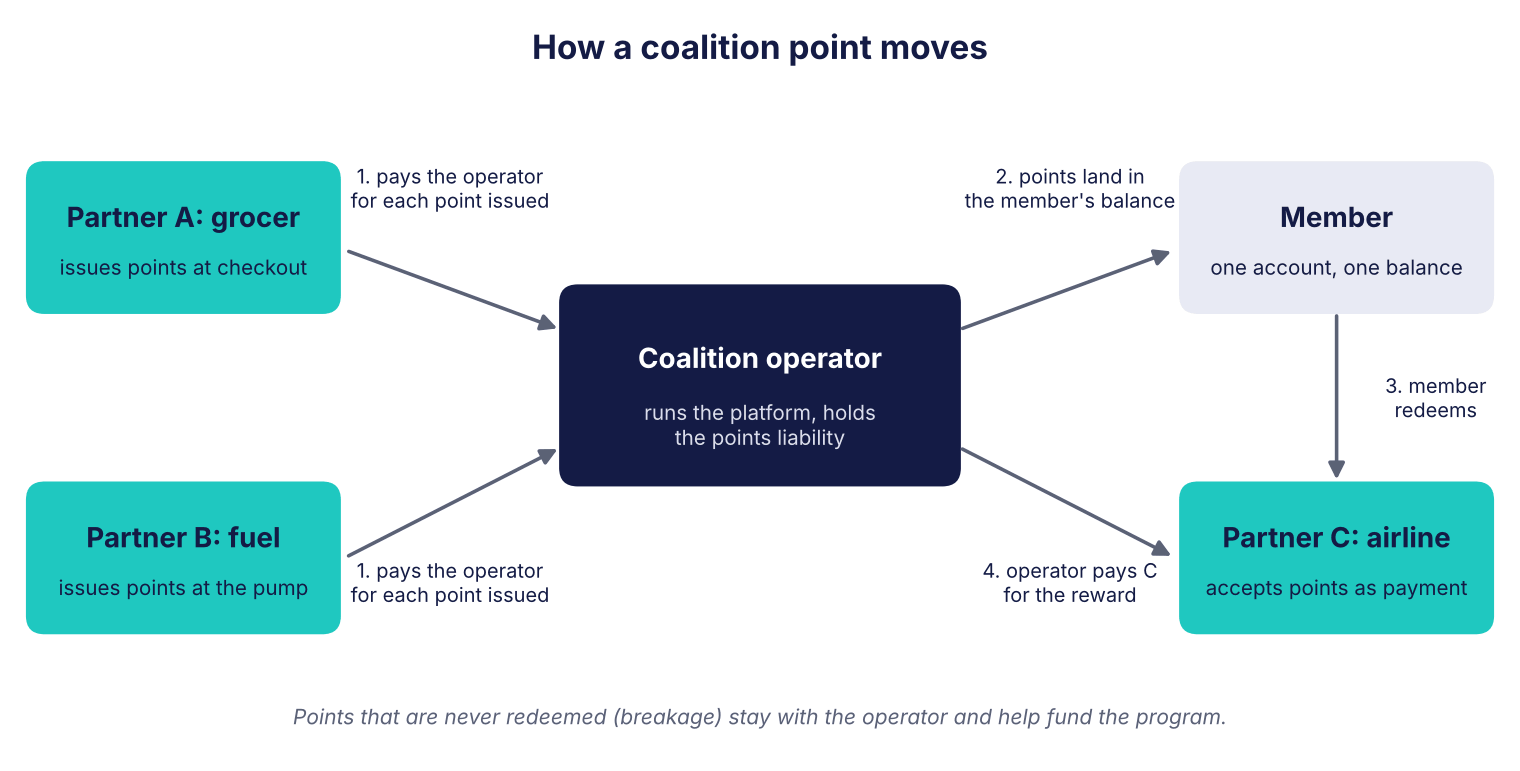
Here is how the process works in practice.
You agree on how points are funded
Before the program launches, you and the other partners agree on how customers earn points, what they’re worth, and how each business pays for the rewards it issues.
For example, when your supermarket awards a shopper 100 points, your agreement with the operator determines how it funds that issuance. The same agreement also explains how redemption costs are calculated and what happens when customers spend those points elsewhere.
Your customers earn points across the network
Imagine a shopper buys groceries from you and earns points. A few days later, they fill up at a participating fuel station and earn more points through the same program.
Your loyalty platform identifies the customer, applies your earning rules, records the purchase, and updates the points balance. The operator then keeps records consistent across the network so customers don’t have to chase missing points.
The operator tracks points and outstanding obligations
Every point you issue needs to be accounted for. The system records which transactions generated points, how many remain unredeemed, and which parties are responsible for funding or settling them under the program’s rules.
This becomes especially important when you issue points that customers later redeem with another brand. Your own transaction records are not enough. You need a reliable way to reconcile activity across the network.
Customers redeem points with other partners
A customer might earn points at your supermarket and later use them to claim an airline reward. Since the airline provides the reward, it needs to be paid for it.
The program operator tracks redemptions and settles the amounts owed between the businesses involved, following the terms they agreed on.
You use permitted customer insights to personalize offers
This is where coalition loyalty becomes more interesting than simply sharing points.
Suppose a customer shops regularly at your supermarket but has never used the fuel partner in your network. If your data sharing agreements and customer permissions allow it, you may be able to use relevant shopping insights to help that partner send a suitable fuel offer.
You can also use permitted insights to make your own campaigns more relevant. Instead of sending the same discount to everyone, you can tailor offers around purchase history, engagement, or the rewards each customer is likely to value.
Of course, these benefits depend on what data you can access and how the program is set up.
Why Your Brand Might Need to Join a Coalition Loyalty Program
A coalition can help you share the costs of running a loyalty program. But the value goes beyond sharing app costs.
Reach customers you cannot reach alone
Let’s say you run a fuel retailer and join a coalition with a supermarket and a pharmacy. The network lets you reach members who already shop with those partners but have never bought fuel from you.
You can use relevant offers to introduce your brand to these customers. Some may give you a try because they can earn points through the same program they already use elsewhere.
Of course, an offer alone does not guarantee a new sale. You still need to give customers a good reason to choose you. The coalition simply gives you another way to reach them.
Give customers more ways to earn and redeem
If customers shop with you only occasionally, they may take too long to earn a useful reward through your standalone program.
A coalition changes that. Your customers can earn points from several partners and accumulate rewards faster. They also have more places to redeem those points, which gives them a reason to keep using the program between visits to your business.
In addition, you can share parts of the loyalty infrastructure and rewards network instead of funding every component yourself. You still need to check the costs and expected return, but you do not have to build the entire ecosystem from scratch.
Use customer insights to make offers more relevant
Your loyalty program may show you what customers buy in your stores. But it may not tell you much about their activity outside your business.
A coalition can give you a broader view of customer behavior, provided your agreements and privacy rules allow you to use that information. You can then use suitable insights to tailor your rewards, messages, and campaigns.
Reasons Most Coalition Loyalty Programs Fail
Coalition loyalty gives you access to a wider network, but it also means working with businesses that have different goals and priorities. These can lead to:
Disputes over pricing and costs
If you are the largest retailer in a coalition, you may feel you are paying too much to support the smaller partners. If you are a smaller partner, you may feel the operator gives the largest brand too much attention.
You need a fair way to price points, share costs, and account for the value each partner brings. Otherwise, even a customer-attracting program can be difficult to sustain.
Disagreements over customer data
You may want to use customer insights from across the network to improve your offers. Another partner may be reluctant to share data that could reveal its customers’ shopping habits.
Before you join, agree on what information you can access, how you can use it, and which activities require customer permission. You should also establish how the operator protects the information and keeps each partner within the agreed rules.
Without that clarity, data sharing can create conflict instead of helping you personalize the customer experience.
Errors in points and payments
If your system records a purchase but the central platform fails to update the customer’s balance, the customer may miss out on their points. If redemption records do not match, you and the other partner may disagree about who owes what.
These problems become harder to manage as the network grows. You need accurate transaction records, clear settlement rules, and a process for fixing errors before they damage customer trust.
Rewards that are not worth earning
You can join a coalition with dozens of partners and still struggle to keep customers engaged if the rewards are too small, take too long to earn, or do not match what customers value.
Look at the program from your customers’ point of view. Can they earn points through purchases they already make? Can they redeem those points for something useful? Do they have a reason to return to your business?
How the Right Technology Helps Your Coalition Work
A proper, documented agreement with other businesses can resolve most of the problems above before you start the program.
But there’s one more limiting step that you need to take care of. And that’s getting the right technology.
The wrong tech forces your system and other businesses’ systems together, creating more errors that end up costing you more than they save.
In contrast, the right one seamlessly connects your partner systems, manages shared rewards, and delivers relevant offers without compromising customer data.
A strong example is Kognitiv, which has managed over 230 million members, 1.2 billion transactions a year, and over 1.1 trillion points redeemed. It supports your coalition loyalty program with loyalty management, personalization, and additional earning and redemption options.
With Kognitiv, you can:
Manage Program Rules and Partner Integrations
When you bring several businesses into one coalition, each partner may have its own point of sale, customer database, and marketing tools. Yet customers still expect their points and rewards to work across the network.
The feature helps you manage the loyalty program behind that experience. You can configure loyalty rules, promotions, rewards, and customer profiles while connecting the program to existing systems. Inspire also offers more than 200 web services and prebuilt integrations with platforms such as Salesforce Marketing Cloud and Braze.
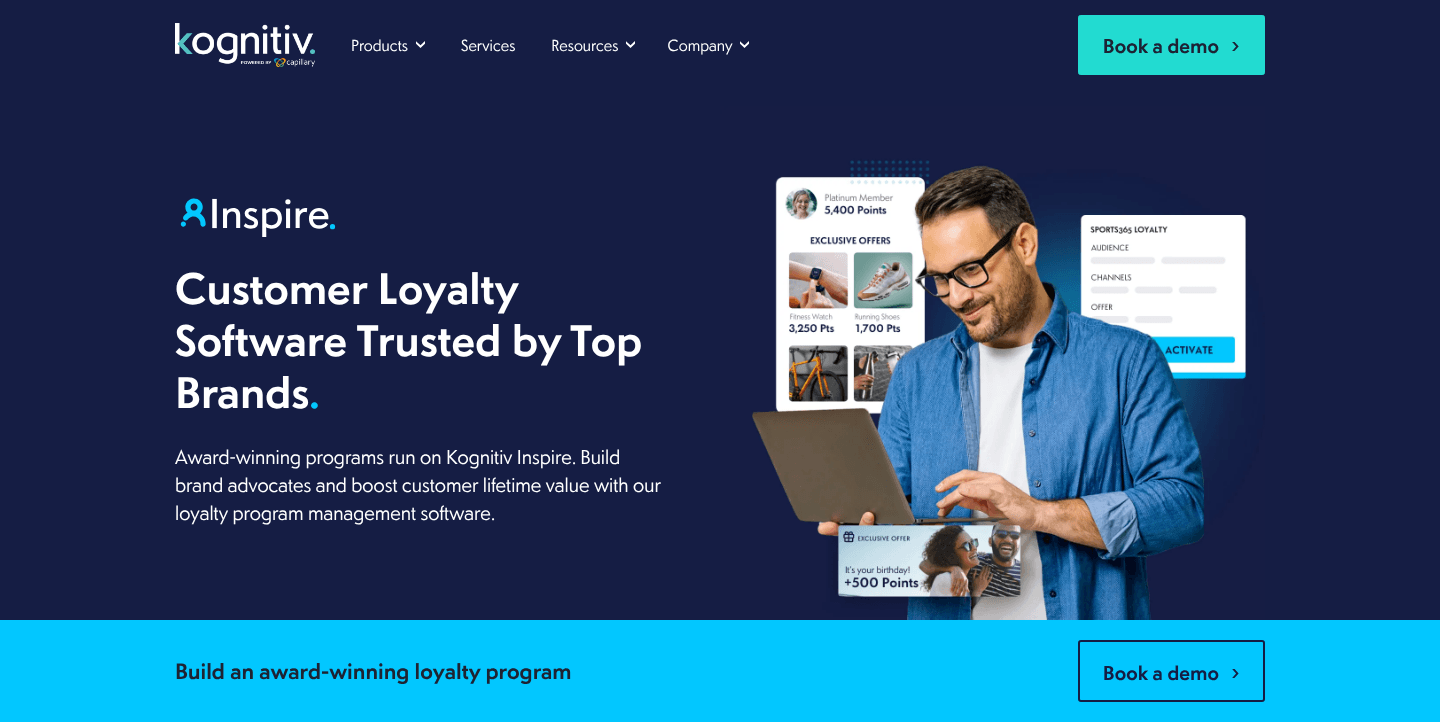
In addition, the platform includes reporting dashboards and fraud detection tools to help you track program performance and identify suspicious activity. These matter when you need to monitor activity across several partners rather than within a single retailer’s loyalty scheme.
Personalize Offers Around Customer Behavior
Connecting your partners is only part of the job. You also need to give members relevant reasons to return and engage with different businesses in your network.
Imagine you run a supermarket that belongs to a coalition with a fuel retailer. Some customers shop with you regularly but rarely visit the fuel partner. Where your data-sharing agreements and customer permissions allow, you could use relevant customer insights to help the fuel retailer reach suitable customers with an offer.
For example, your supermarket might want to encourage more frequent purchases, while the fuel retailer wants to increase visits. Instead of giving every member the same discount, each partner can build campaigns around the behavior it wants to encourage, using customer information it is permitted to access.
The goal is to make the shared program more relevant to each member without losing sight of what each partner needs from it.
Expand Earning and Redemption With Kognitiv Marketplaces
Kognitiv Marketplaces lets you extend your core program with additional earning and redemption options. This makes your coalition more useful by giving members more ways to earn and spend their rewards.
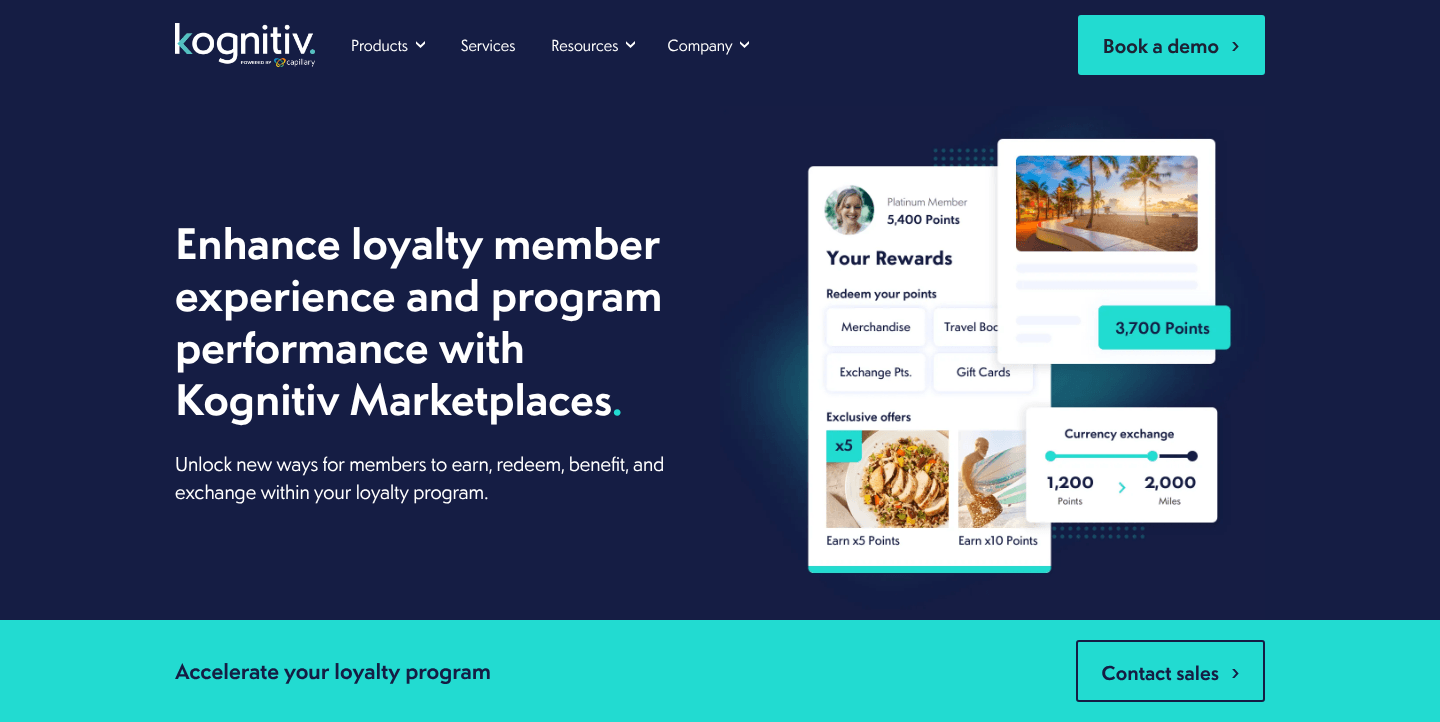
You can give merchandise, gift cards, charity donations, and travel rewards through a branded marketplace. Card-linked offers give members another way to earn points on eligible purchases, while affiliate offers let them earn rewards when they shop with selected online retailers. Where your program supports it, currency exchange also lets members convert one loyalty currency into another partner’s currency.
Marketplaces can also display offers and rewards based on customer behavior and preferences. This gives you more flexibility than presenting every member with the same catalog.
Together, Inspire and Marketplaces help you manage the core loyalty program and extend the ways customers can earn, redeem, and benefit across your partner network. Ignite adds another layer by helping you personalize the offers and communications that encourage those behaviors.
Case Study: How Kognitiv Supports yuu Rewards
Since launching in Hong Kong in 2020, yuu Rewards has grown to more than five million members, connecting over 2,500 stores and 40 online platforms across Hong Kong and Macau.
The program’s clearest reported outcome came in 2021, when DFI Retail Group’s Rewards attracted almost four million members, with over 130 billion points issued and 64 billion redeemed since launch. More importantly, the shared yuu points currency supported a more than 50% increase in cross-banner shopping since the start of 2021.
According to Kognitiv, its team worked with yuu’s technology team to connect multiple systems, from point of sale to Kognitiv Inspire. The resulting loyalty technology supports millions of transactions, reward issuances, and redemptions every day in near real time.
Beyond this integration, Kognitiv’s broader platform offers tools to build a shared rewards program. Inspire manages loyalty rules, promotions, and rewards, while Ignite uses AI to personalize offers and messages around customer behavior. And Marketplaces adds more ways for members to earn and redeem rewards through partner benefits.
Is Coalition Loyalty Right for Your Brand?
A coalition is a good fit if you want to reach customers beyond your existing audience, encourage more frequent purchases, or connect several brands under one rewards program.
It can be especially useful if your customers already buy from complementary categories. For example, you could join a network with a supermarket, fuel retailer, and pharmacy, giving customers more ways to earn points while introducing your brand to shoppers who already use the other partners.
However, coalition loyalty is not right for every business. If your strategy depends on keeping the customer relationship exclusive, you may not want to share program control or customer insights with other brands. It may also be difficult to justify the cost if the partner network offers few useful earning or redemption opportunities for your customers.
Before you join a coalition or choose a platform, ask yourself four questions:
- Can you agree with the other partners on point values, reward funding, and settlement rules?
- Can the platform connect to the systems you already use?
- Do you have clear rules for data access, customer permissions, and personalization?
- Will your customers have enough useful ways to earn and redeem points to keep them engaged?
If you can answer these questions clearly, you have a stronger foundation for the program. The right technology can then help you connect your partners, manage the points, and use permitted customer insights to make your loyalty program more useful to customers and more valuable to your business.
Frequently Asked Questions
The best platform depends on your program’s needs, including partner integrations, shared rewards, and points settlement. Kognitiv is worth considering for enterprise coalition programs. Its Inspire platform manages loyalty rules and partner integrations, while Marketplaces expands earning and redemption options. Kognitiv also supports yuu Rewards in Hong Kong, a coalition connecting thousands of stores and online platforms through a shared loyalty program.
In a partner program, you own the loyalty scheme and work with selected businesses to add earning or redemption options. In a coalition, an operator coordinates a shared rewards program across several participating brands. Your customers can earn and redeem points across the network, subject to its rules
The businesses that issue points usually contribute to the program under agreed commercial terms. When a customer redeems points with another partner, the operator or program settles the amount owed according to the coalition’s settlement model. Your agreement should explain how those costs and liabilities are allocated.
yuu Rewards in Hong Kong connects DFI Retail Group’s retail network with external partners through one loyalty program, and Kognitiv powers the system integrations to make it work. Another example is the Air Miles Middle East program.
You need a platform that can record earning and redemption transactions, manage shared points, connect partner systems, reconcile settlement, and support reporting and fraud controls. You also need customer data and personalization capabilities that respect your program’s privacy rules. Kognitiv Inspire supports loyalty management and integrations, while Kognitiv Marketplaces adds more ways for your customers to earn and redeem rewards.