


Latin America has roughly 2 million software developers, and Brazil plus Mexico account for about 1.32 million of them. That makes the region a high-capacity nearshore market, not a niche backup plan.
The popular advice says to hire Latin American developers because they're cheaper. That's the wrong starting point. The better business case is time-zone overlap, deep full-stack benches, and a hiring model that protects retention instead of creating a two-tier team.
Table of Contents
- Why Latin America Is a Nearshore Powerhouse
- Sourcing and Assessing Talent Effectively
- Market Rates and Fully Loaded Costs
- How LatHire Can Help
- Choosing the Right Engagement Model
- Onboarding, Culture Fit, and Retention
- Building Your Nearshore Hiring Roadmap
Why Latin America Is a Nearshore Powerhouse
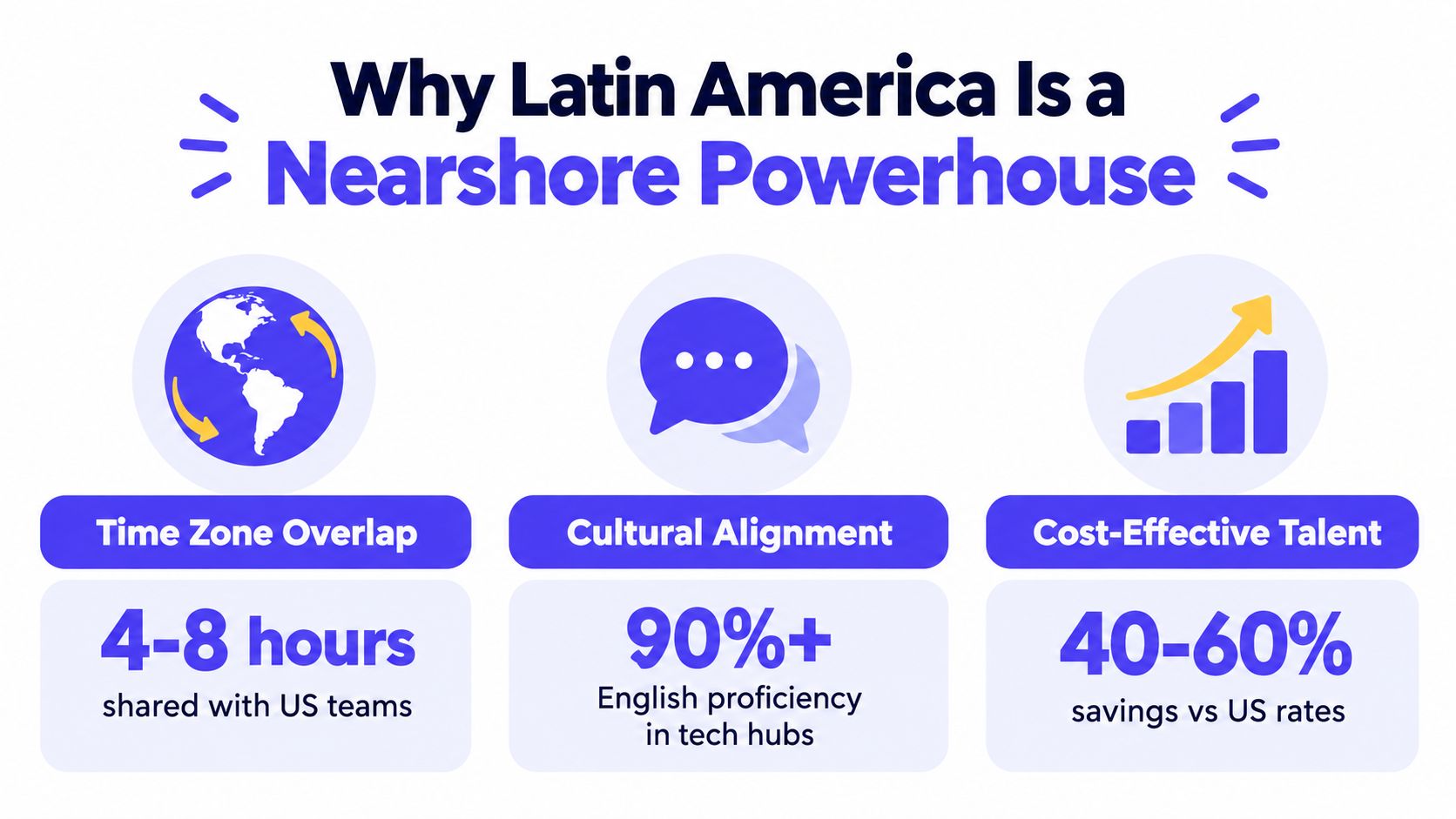
The cheapest-hire story misses what makes Latin America useful for US teams. Cost matters, but it is only one variable. If your developers are asleep when your PM, designer, and backend lead are online, you have not bought speed, you have bought delay.
The core advantage is operating fit
A 2024 estimate places Latin America at approximately 2 million software developers, with Brazil at 759,278 and Mexico at 563,075. Those two countries alone make up roughly 1.32 million developers, about two-thirds of the nine-country total in that estimate, which also includes Argentina, Colombia, Chile, Peru, Ecuador, Costa Rica, and Uruguay. That scale matters because it lets you recruit repeatedly, not just opportunistically. The source treats the total as directional and notes there is no single official census, so the right read is capacity, not false precision. Latin America developer population by country
For practical hiring, hire Latin American developers is a strategy for teams that want synchronous work, not just lower payroll. Brazil, Mexico, Argentina, Colombia, and Chile are large enough to support different hiring needs, from specialist searches to full distributed squads. Smart teams stop asking whether the region is “cheap” and start asking whether it is close enough, deep enough, and stable enough for the work they need to ship.
Practical rule: if your team needs same-day feedback loops, prioritize operating fit first and salary second.
Time zones and language shape the day-to-day
Latin America's biggest advantage is that much of the region works within the same business day as North America. That creates real collaboration, not the async-only rhythm that slows reviews, handoffs, and debugging. It also helps explain why nearshore teams often feel more integrated than offshore teams, even when pay is still meaningfully lower than US rates.
Language and working style matter too. US teams usually care less about whether a developer lives in a “near” country and more about whether they can join standups, absorb product context, and resolve blockers without three layers of translation. Latin America often gives you that blend of proximity, shared work hours, and strong engineering density. For a founder or engineering manager, that combination is the point.
Sourcing and Assessing Talent Effectively
Sourcing in Latin America works best when you stop treating resumes as proof and start treating them as leads. The market has depth, but depth doesn't remove the need for a tight screen. A candidate who has shipped real production work is easy to spot once you know what to test, and easy to miss if you rely on titles alone.
Where strong candidates usually come from
The best pipelines tend to be a mix of curated platforms, recruiter networks, and communities where developers show their work. Revelo's 2024 report is a good example of why curated networks matter, it analyzed more than 185,000 software developers who had joined its pre-vetted network since 2022 across 12 Latin American countries. Within that network, full-stack developers were 23%, front-end 21%, and back-end 18%, which shows how much of the market maps directly to product engineering needs. Revelo 2024 developer network report
That kind of distribution tells you something important. If you're hiring for product teams, front-end work, or full-stack delivery, the region isn't just available, it's structurally aligned with those roles. It also helps explain why recruiters who know the region can move faster than generic global sourcing. They aren't guessing where the talent is concentrated, they're already looking in the right places.
A useful sourcing stack usually includes:
- Curated talent pools, for speed and early quality control.
- Open-source activity, for candidates who can prove their coding habits.
- Specialized recruiters, when you need multiple hires across countries.
- Referrals from current LATAM engineers, because they understand the local market better than most US hiring teams.
How to assess front-end skill without guessing
For front-end roles, the most useful interview doesn't start with “tell me about your strengths.” It starts with a live or take-home task that resembles production work. If your team uses Tailwind CSS and Figma, ask candidates to rebuild a component from a design file, then explain the trade-offs in spacing, responsiveness, and maintainability. You'll learn more from that than from another abstract discussion about “component architecture.”
The best test is the one a strong engineer would recognize as real work.
A good exercise can be simple but demanding. Give the candidate a Figma frame, a design system token set, and a component target. Then ask for semantic HTML, responsive Tailwind classes, and a brief explanation of how they'd avoid drift if the design changed later. If they can talk through accessibility, state handling, and layout behavior without hand-waving, you're in the right range.
For interviews, keep your questions concrete:
- State management: how would you handle a component that has loading, empty, error, and success states?
- Responsive behavior: what happens to this layout on a smaller screen, and why?
- CSS strategy: when do you prefer utility classes, and when do you extract patterns?
- Design fidelity: what do you do if a Figma file and the component library disagree?
A candidate who can answer those directly is usually much stronger than someone who merely says they “know React.” The point is to test production judgment, not terminology.
Market Rates and Fully Loaded Costs
The biggest mistake in LATAM hiring is treating salary as the total cost. It isn't. A developer's monthly pay is only one line in the budget, and once you add compliance, benefits, equipment, and replacement risk, the apparent saving can shrink fast.
What salary ranges can and can't tell you
Published market estimates put LATAM mid-level developers around $3,000 to $4,500 per month and senior or full-stack developers around $4,200 to $5,500. Those figures are directional, and they shift by country, specialty, and engagement type. International employers may also pay roughly 1.5 to 2 times local-market averages when they want English fluency, US-time-zone overlap, or prior international experience, which shows how quickly the market splits between local pricing and export pricing. A separate market view from Deloitte also points to stronger salary pressure in digitally skilled roles, especially where companies compete for scarce talent and cross-border experience.
That split matters. If you only compare “cheap Argentina” with “expensive Brazil,” you miss the true segmentation. Senior engineers with international experience often sit on a different pricing curve than domestic-only candidates, and that curve keeps moving up. The result is straightforward, buyers who still expect old-school arbitrage usually end up disappointed.
Build the total cost from the start
Price the full employment path before you make an offer. Include compensation, payroll or EOR fees, equipment, benefits, paid leave, recruiting time, and the cost of replacing someone who leaves early. Leave those out, and you will overrate models that look cheap on paper but create friction in practice.
Practical rule: compare fully loaded cost, not posted salary, or you will choose the wrong country for the wrong reasons.
Retention changes the economics too. Staff-augmentation providers report roughly 75% to 85% 12-month retention, while direct or EOR hires are reported above 90%. That does not make staff augmentation a bad model, but it does mean the employment structure affects the actual cost of the hire. LATAM hiring model and retention guidance A similar pattern appears in broader retention discussions from other LATAM hiring operators, which point to better stickiness when companies give people a clearer long-term path.
The smartest founders I have seen do three things before they make an offer:
- Benchmark by country and seniority, instead of using broad regional averages.
- Model the full employment structure, including payroll or EOR fees.
- Account for replacement risk, because an early exit can erase months of savings.
If you are hiring a senior engineer to own critical product work, the best deal is rarely the lowest sticker price. It is the developer who ships reliably, overlaps with your team, and stays long enough to build institutional knowledge.
How LatHire Can Help
When teams want speed without building a full LATAM sourcing and compliance function, a specialized platform can compress the process. LatHire is built around that problem, it connects US and Canadian companies with pre-vetted Latin American professionals across technology, marketing, sales, and operations, and it adds screening, payroll, benefits, and compliance support in one place. For hiring managers who need to move quickly, that combination can remove a lot of coordination drag.
A useful place to start is the platform's hire latam developers resource, especially if you want to compare engagement paths before making a direct hire, EOR, or staffing decision. The value isn't just candidate access, it's the reduction in administrative friction. If a team doesn't have in-house expertise in local payroll, benefits, or cross-border paperwork, a managed workflow can be the difference between “we opened the search” and “we made an offer” without stalling in the middle.
The right fit is usually a team that wants pre-vetted candidates, faster matching, and less back-office overhead than a direct sourcing program. It's especially useful when you need to hire across multiple functions or when your internal HR team doesn't want to become a cross-border compliance shop. If your company already has a strong legal and recruiting operation, direct hiring can still make sense, but if you want a more packaged route, this is the kind of tool that shortens the path.
Choosing the Right Engagement Model
The engagement model is where many teams get overconfident. They assume the “best” option is the one that sounds simplest, then discover that legal exposure, onboarding speed, and team integration all change depending on the structure. The right answer depends on whether you're optimizing for control, compliance, or flexibility.
Direct employment, EOR, and staffing each solve a different problem
Direct employment gives you the most control over culture, expectations, and long-term planning. It also requires you to handle local compliance properly, which is not trivial across Latin America. An employer of record shifts that legal burden to a third party while letting you manage the developer's day-to-day work, which is why it's often the cleanest path when you need formal employment without opening a local entity.
Staffing or partnership models sit somewhere else on the spectrum. They're useful when you want flexibility and speed, especially for project-based work or when you're still learning which country, stack, or seniority level fits best. The trade-off is usually less direct control and a different retention profile than a direct hire.
| Model | Best for | Trade-off |
|---|---|---|
| Direct employment | Long-term ownership and tight cultural integration | More compliance work |
| Employer of Record | Fast, formal employment without local entity setup | Added monthly platform cost |
| Staffing or partnership | Flexible scaling and managed hiring support | Less direct control, often higher hourly cost |
Build your decision around risk and ramp time
The common nearshore mistake is assuming geography automatically removes coordination risk. It doesn't. If ownership is unclear, onboarding is thin, or the team can't agree on decision rights, a developer in another country can feel further away than one sitting in the next room. That's why you want the employment model to match your management maturity, not just your budget.
For fast-moving teams, a managed model can be the better starting point because it reduces the number of decisions you need to get right on day one. For companies with strong internal operations and a stable roadmap, direct employment can make sense because the relationship is easier to deepen over time. The right choice is the one that lets the engineer do focused work without creating avoidable legal or administrative drag.
If you can't explain who owns payroll, compliance, onboarding, and performance management in one sentence, the model is too fuzzy.
Onboarding, Culture Fit, and Retention
Hiring is the easy part to celebrate and the hard part to make durable. LATAM developers often have strong demand from international employers, which means good people can leave if the job feels like a dead-end or a second-class seat. Retention is not a nice-to-have, it's the difference between building institutional knowledge and restarting every six months.

The best teams treat remote LATAM engineers like core staff from the first week. That means the same planning rituals, the same architecture discussions, and the same visibility into product decisions. If a developer only gets tasks and status checks, they'll usually behave like a vendor. If they get context, ownership, and feedback loops, they start behaving like a partner.
Retention needs structure, not slogans
The strongest retention systems are boring on purpose. They make growth visible, decision-making clear, and career progression legible. In practice, that means documented promotion levels, paid learning time, participation in architecture discussions, and transparent compensation-review rules. None of those are glamorous, but each one reduces the odds that a good engineer starts browsing elsewhere.
There's also a cultural risk that shows up when companies pay international premiums but don't create a real path forward. That can produce a two-tier workforce where remote LATAM engineers do the hard execution work while local staff get the strategic visibility. That structure doesn't last. People notice who gets invited into planning, who gets mentoring, and who gets a say in decisions.
A hiring process that keeps people
A practical onboarding sequence looks like this:
- Set a 30/60/90-day plan with visible milestones.
- Define the first deliverable in production terms, not abstract tasks.
- Include the developer in architecture and customer-feedback conversations early.
- Review compensation and role growth transparently, not ad hoc.
- Document responsibilities and decision rights, so ownership isn't ambiguous.
If you do that well, retention stops being luck. It becomes part of how the team is designed.
A good LATAM hire should feel like an extension of your product team, not a parallel lane. That only happens when onboarding, feedback, and advancement are intentional. If you wouldn't tolerate unclear growth for someone in your main office, don't tolerate it for someone joining from another country.
Building Your Nearshore Hiring Roadmap
The cleanest hiring roadmap starts before the job post goes live. Define the role around outcomes, not a list of technologies. If the role is front-end, backend, or full-stack, decide what success looks like in the first three months, because that shape determines who you should source and how you should evaluate them.
A sequence that actually works
Start with country selection, but only after you know what you need from the hire. If you need same-day collaboration and tight overlap, prioritize countries and time zones that fit your cadence. If you need deeper English screening or a more enterprise-heavy stack, make that explicit in the brief instead of assuming a broad “LATAM developer” pool will solve it.
Then move to sourcing and testing. Use curated platforms, recruiter networks, or referrals, but keep the assessment real. A coding exercise tied to your actual stack will tell you more than a generic algorithm challenge, especially for product engineering roles where judgment matters as much as syntax. If the candidate can explain trade-offs clearly, that's usually a better signal than memorized trivia.
After that, choose the engagement structure with your legal and ops constraints in mind. Direct employment, EOR, and staffing all work, but only if the model matches your compliance comfort and growth plan. Many teams rush through this step, and it is also where the hidden friction starts.
What to check before the offer
- Role definition: the output, scope, and first 90 days are written down.
- Skills proof: the candidate has passed a work sample tied to the role.
- Engagement structure: payroll, compliance, and benefits are assigned.
- Onboarding plan: equipment, access, and the first delivery milestone are ready.
- Retention path: the developer can see growth, not just tasks.
Once the hire starts, treat onboarding like product work. Give the developer a narrow first win, then widen scope only after the handoffs and expectations are clear. The goal isn't just to fill a seat, it's to build a team that keeps shipping without rediscovering the same problems every quarter.
If you're ready to hire Latin American developers, start with the work itself, then choose the country, the model, and the process that fit your team's real constraints. For product teams and agencies that need practical building blocks, Pagedone can help speed up the interface side of the workflow while your hiring system catches up.